The Menu Is Twelve Pages. Your Order Was Decided Before You Sat Down.
The Cheesecake Factory menu has something like 250 items. You have probably ordered the same four. This is not a personal failing; it is a feature of how menus, memory, and appetite collude. Somewhere between the laminated pages and the server's arrival, a quiet sorting happens. Most of us do not read the whole menu. We scan for the familiar, the safe, the thing we meant to try last time and then didn't. The result: a restaurant can offer dozens of possibilities and still serve the same 20 percent of orders over and over.
The Menu Is a Novel You've Already Read
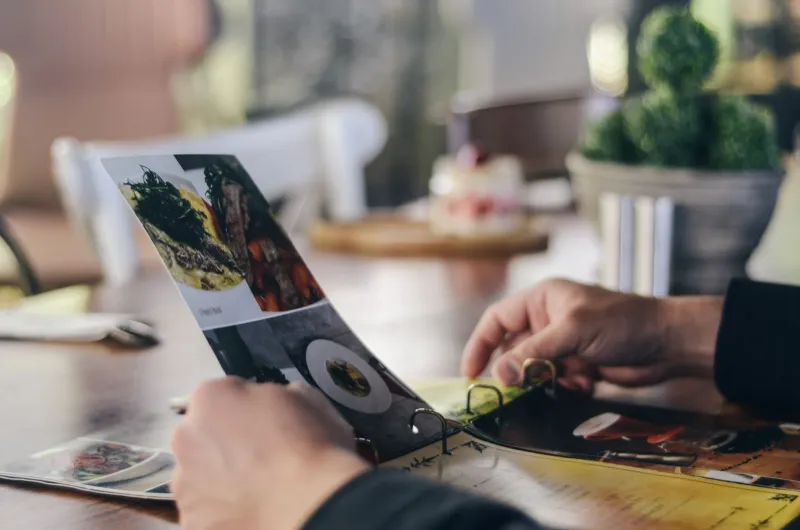
A menu is not a neutral list. It is a persuasive document with a spine. Restaurants know that diners spend about a minute or two with it, not an afternoon. So they arrange the page like a stage: the star entree at the top of the section, the high-margin pasta in a box, the photo of the burger that makes your decision before your brain catches up. The familiar 20 percent is not just your favorites; it is the items the menu has trained you to notice.
Menu engineers talk about the golden triangle—the upper middle, the top right, the spot where the eye lands first. They talk about decoys, those expensive items that make the next price down look reasonable. They talk about anchors and bundles. None of this is sinister. It is just design. But design has a direction, and it is usually toward the same chicken dish you ordered in 2019.
Decision Fatigue Orders the Appetizers
By the time you sit down, you have made hundreds of small decisions. What to wear, what route to take, whether to reply to that email, which parking spot to circle. Choosing from 80 items is not a treat; it is a chore with bread. Psychologists call it choice overload. The brain reaches for the least effortful option: the thing you liked before. This is why the same dish follows you across cities and cuisines. The menu says new; your appetite says known.
There is also the social math. You do not want to be the person who holds up the table. You do not want to ask the server three questions and then order the salmon anyway. The fastest way to end the conversation is to say the thing you always say. The usual is a social lubricant.
Nostalgia Is a Seasoning
Ordering the same dish is a form of time travel. The chicken marsala you had on a first date. The pad thai from the place near your old apartment. The breakfast burrito you ate the morning after a bad week. Taste and memory are neighbors in the brain, which is why a single bite can deliver a whole era. The 20 percent is not just preference; it is a highlight reel with a menu attached.
Restaurants capitalize on this, gently. Since 1974. Original recipe. The one you remember. Nostalgia is a seasoning that costs nothing and sells everything. When you order the familiar thing, you are not just buying dinner. You are buying a rerun of a feeling.
Your Menu Personality: A Self-Audit
Answer honestly, then count your letters. Mostly A, B, C, or D.
-
The server sets down the menu. You: A) flip to the section you always order from; B) read every item and calculate value; C) ask what is new; D) look for the dish you had on a memorable night.
-
The menu is 12 pages. Your first thought: A) thank goodness, my section is here; B) how are the prices structured? C) I am overwhelmed; D) I wonder if they have that thing I loved.
-
You order the same dish at a new restaurant. You feel: A) loyal; B) efficient; C) boring; D) sentimental.
-
Your ideal menu: A) three things, all good; B) clear value; C) a tasting menu; D) a greatest-hits list.
-
You regret a new order. Next time you: A) return to the usual; B) analyze what went wrong; C) try something else; D) order the memory dish.
-
The check arrives. You think: A) worth it; B) could have split; C) next time I will be brave; D) that was a nice rerun.
Mostly A: The Loyalist. You know what you like, and you are not sorry. Mostly B: The Calculator. You want the best deal and the least waste. Mostly C: The Magpie. You are drawn to novelty, even when it costs you. Mostly D: The Nostalgist. You order with your memory, not your stomach.
Breaking the Loop Without the Regret
You do not have to become a menu anarchist. You just need a few low-stakes moves.
-
Pre-commit before you sit down. Look at the menu online and pick one new candidate plus one backup. The decision is easier when you are not hungry and not being watched.
-
Keep the familiar thing as a side or appetizer. You still get the taste; the main event gets to be an experiment.
-
Use the two-bite rule. Try someone else's new dish. Two bites tell you most of what you need to know, and you still have your own dinner.
-
Ask the server one question: What do regulars order that is not the obvious bestseller? This is not a trap. It is a shortcut.
-
Set a regret budget. If the new dish is bad, you still have bread, a story, and the right to order the usual next time. A bad meal is not a character flaw.
-
Rotate your usual. Same category, different restaurant. If you always get pad thai, get pad thai somewhere new. You keep the comfort and change the context.
The 80/20 Special
The point is not to abolish your favorites. The point is to notice the shortlist in your head. The menu is an invitation, not an exam. Order the usual if you want. But once in a while, let the other 80 percent have a turn. The best order is the one you actually wanted, not the one you defaulted to because the menu was long and the server was waiting.