Twelve Tools Run Your Kitchen. The Rest Are Just Furniture With Handles.
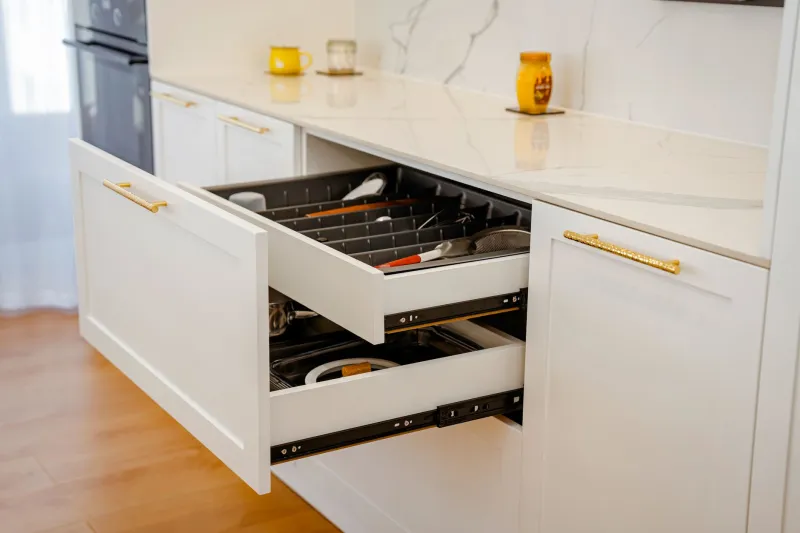
There's a drawer in your kitchen you don't open on purpose. It opens itself, usually when you're reaching for a bottle opener and instead find a melon baller, a set of corn-on-the-cob holders shaped like tiny cows, and the avocado slicer you bought in a moment of aspiration.
We all have one. The question worth asking on a random Tuesday night in November 2026 is simpler than it sounds: how many of these things actually cooked dinner this week?
The Immovable Twelve
Do a real count. Not the idealized count you'd put on a wedding registry. The actual one.
Most home kitchens run on a shockingly small crew. A chef's knife and a cutting board. One saucepan, one skillet. A sheet pan with the permanent patina you've stopped trying to scrub off. A wooden spoon that's older than some of your friendships. Tongs. A colander. Maybe a Dutch oven if you're the soup type, a nonstick pan for eggs if you're honest about your mornings.
That's the whole engine. Twelve items, give or take, doing the work of a hundred. The rest of the cabinet is essentially a museum of your past selves — the version who was going to bake sourdough, the version who was going to host fondue night, the version who genuinely believed a strawberry huller would change things.
Doing the Math on Your Own Shelf
Here's the check that stings a little. Pick a normal week — not Thanksgiving, not the week you tried meal prep and quit by Thursday. Write down every tool you touched.
Most people land somewhere near 15 to 20 percent of their kitchen inventory. That sliver is doing 80 percent of the cooking, the cleaning, and the quiet emotional labor of feeding yourself. The other 80 percent of the stuff? It's holding cabinet space and, in some cases, holding a grudge.
The Dust Colony, Ranked by Guilt
Every kitchen has its own roster, but a few repeat offenders show up everywhere.
The bread machine. Bought with real optimism. Used twice. Now a bread-shaped monument to January.
The fondue set. Beautiful box. Never opened since 2019. You are not, statistically, a fondue household, and that's fine.
The avocado slicer. The avocado already comes with a slicer. It's called a knife.
The juicer. This one is complicated. Fresh juice is great. Cleaning a juicer is a part-time job with no benefits.
The panini press. A grilled cheese machine that takes up more counter than the microwave and produces a sandwich you could've made in a skillet in the same amount of time.
None of these are crimes. They're just not earning rent.
The Four-Question Exit Interview
Before anything leaves the cabinet — or before anything new comes in — run it through a short interrogation. Be honest, because the gadget can't argue back.
- Did I use this in the last twelve months? Not 'could I,' not 'someday.' Did I?
- Does it do something my knife, skillet, or sheet pan can't?
- Would I buy it again today, at full price, with my own money?
- If a friend were moving and offered me this, would I take it?
Two yeses is a keeper. One is a maybe. Zero means it's time to have the talk.
The Case for the Weird Single-Use Thing
Now, a counterargument, because the 80/20 rule has a sense of humor.
Some single-use tools are absolutely worth the shelf space, and the test isn't 'is it versatile.' It's 'does it remove a specific, recurring misery?'
A cherry pitter is a useless object until cherry season, at which point it's a small miracle. A microplane does roughly one job and does it so well it feels unfair. A rice cooker is technically single-purpose and quietly runs entire weeks of dinners. A waffle iron is a single-use gadget that produces joy, and joy counts.
The distinction is frequency of dread removed, not frequency of use. If a tool kills a chore you genuinely hate four times a year, it's not clutter. It's a tiny employee.
Building a Countertop That Pulls Its Weight
The goal isn't minimalism. Minimalism is a lifestyle brand, and you live in a kitchen. The goal is a working 20 percent that you can actually reach without moving anything.
Start with the front row. Whatever you touch daily should live at hand height, unblocked, no stacking. The back row is for seasonal stuff and the Instant Pot you're still deciding about. The top shelf belongs to the things you love but rarely need — the big roasting pan, the cake stand, the serving platter shaped like a leaf.
Then apply the rule to countertops, too. If a machine hasn't been plugged in since spring, it's not an appliance anymore. It's decor. And if it's decor, it should be pretty or it should be gone.
The Drawer Is a Diary
The strange thing about kitchen clutter is that it's not really about cooking. The avocado slicer is a memory of a version of you with more time. The fondue set is a promise about dinner parties that haven't happened yet. The bread machine is hope, sealed in plastic.
You don't have to throw any of it out today. But you can stop pretending it's part of the team. Count the twelve that cook your meals, and thank them — genuinely, out loud, if the mood strikes. Then open the guilty drawer, look the corn-cob holders in the eye, and ask the only question that matters: are you coming to Thanksgiving or not?